Last Updated on May 16, 2026
With computers getting more advanced and Microsoft adding more features to Windows (especially AI), it has become a bit more challenging to diagnose and repair your computer when it crashes. Sure, we now have the Windows Quick Machine Recovery Repair (QMR) feature but that has not proven to be the breakthrough Microsoft thought it would be.
This is where a third-party repair and recovery USB toolkit can help you out. You have many choices when it comes to these tools including Live USB Malekal and Medicat. But there is also a tool called Hiren’s Boot CD that has been around for years and offers a variety of tools to help you recover data, repair disks, reset passwords and more.
Even though it has CD in the name, Hiren’s is still a tool most commonly used on a USB flash drive since it’s too big to fit on a CD but will still fit on a DVD. You will need to download the Hiren’s ISO file from their website and then create a bootable USB drive using your favorite bootable USB drive creator app.
1. Configure Your Flash Drive with Rufus
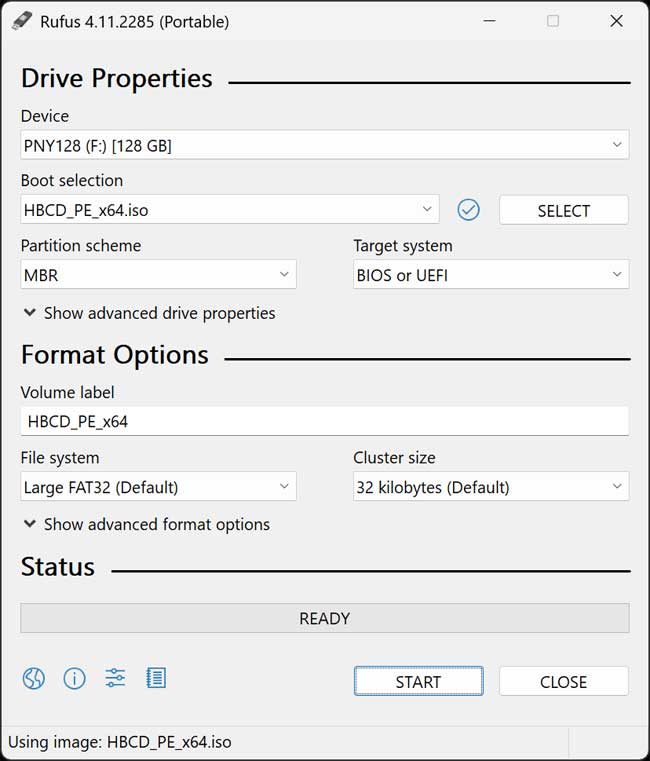
One app you can use to make your flash drive is called Rufus and it’s one of the more popular apps used to create things such as bootable Windows or Linux installation flash drives. Rufus is easy to use and all you need to do is choose your USB flash drive, browse to your Hiren’s ISO file and configure a couple of options and click on the Start button. What options you choose to create your flash drive will vary depending on what type of computer you will be using it on.
2. Enable Dual UEFI and BIOS Mode
When we say what type we mean its age, if it is using BIOS or UEFI, if it has secure boot enabled and so on. You may have to do a little research on your end to figure this out, but most people use MBR for the partition scheme and FAT32 for the file system. One thing you may want to do is press Alt+E on your keyboard before starting the process with Rufus. This enables Dual UEFI/BIOS mode (sometimes called hybrid mode) in Rufus. When this is enabled, Rufus changes how the flash drive is created so it can boot on both legacy BIOS systems and modern UEFI systems from the exact same USB drive.
3. Verify the Flash Drive Contents
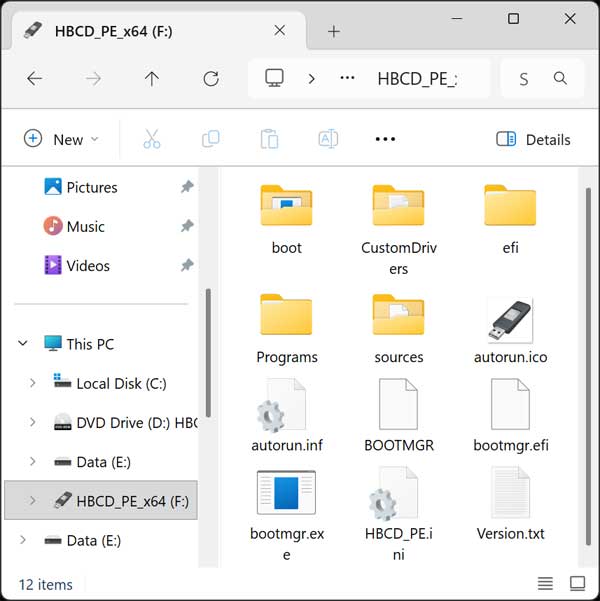
Once you have your flash drive completely created and the Rufus software finishes its writing sequence, you can safely open it up in File Explorer. This allows you to visually verify the installation and see exactly what types of files and folders it actually contains. You should see essential boot components like the bootmgr files and an EFI folder sitting right in the root directory.
4. Boot into the Hiren’s PE Interface
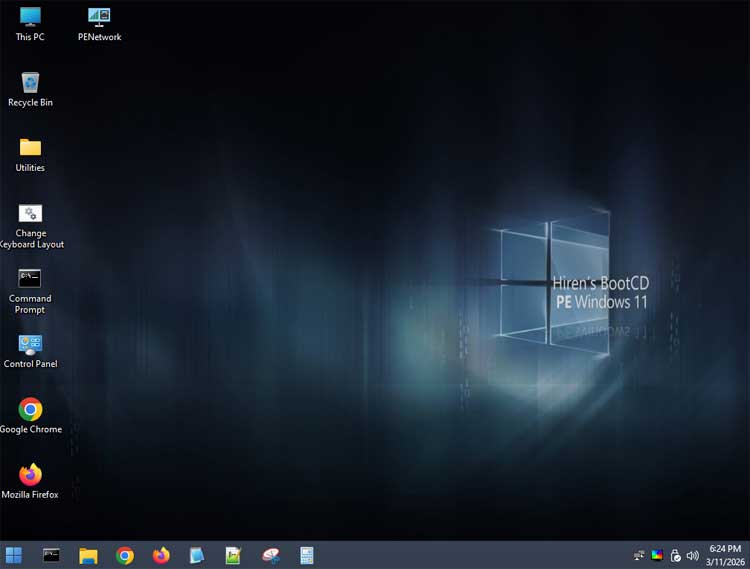
You can then safely eject the USB stick and plug it directly into the problematic machine. Boot the problematic computer with the flash drive selected as the primary startup device to successfully load the Hiren’s Boot CD interface. This preinstallation environment consists of its own custom desktop, a familiar taskbar, and a standard start menu to make navigation incredibly easy.
5. Browse the Included Software Tools
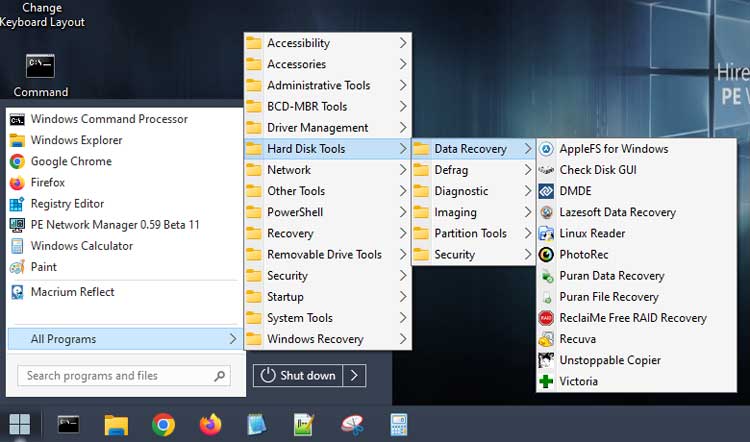
If you click on the start menu and navigate to All Programs, you will instantly see all the available tools that come pre-packaged with the toolkit. The developers have conveniently broken the software down into logical categories so you do not have to blindly hunt for specific repair utilities. Here is a breakdown of the specific tools you will find sorted into their respective folders.
1. Boot and MBR Repair Tools
When a computer flat out refuses to load Windows, the master boot record is usually completely corrupted. Hiren’s includes dedicated utilities like BootIce and EasyBCD to help you actively rebuild those missing partition tables. You can use these to manually rewrite the boot sector and force the operating system to load normally again.
2. Hard Disk Data Recovery Software
Accidentally deleting important files or suffering a catastrophic drive failure is a massive nightmare. The toolkit packs heavy hitters like Lazesoft Data Recovery, Recuva, PhotoRec, and Puran File Recovery to aggressively scan your raw sectors. It also includes CheckDisk GUI and Unstoppable Copier to physically rescue corrupted data from dying hard drives before they fail completely.
3. Disk Defragmentation and Health Diagnostics
Before attempting to clone a drive, you need to verify its physical mechanical health. You can easily run utilities like CrystalDiskInfo, HDTune, GSmartControl, or HDDScan to check the S.M.A.R.T. data and look for failing sectors. If you just need to optimize a fragmented mechanical drive, the included Defraggler app handles that process perfectly.
4. Imaging, Backup, and Partition Management
Moving data from a smaller drive to a larger SSD requires specialized cloning software. Hiren’s includes industry standards like Macrium Reflect PE, AOMEI Backupper, and Drive Snapshot to create perfect 1:1 image backups. You can also manipulate your drive volumes without losing data using AOMEI Partition Assistant, DiskGenius, or EaseUS Partition Master.
5. Windows Recovery and Security Utilities
Sometimes a virus completely locks you out of the file system. You can quickly run the ESET Online Scanner or McAfee Stinger to nuke malware before Windows even boots up. It also includes Lazesoft Windows Recovery for deep system repairs, and tools like VeraCrypt and HDD Low Level Format Tool for securing or permanently destroying sensitive data.
6. Key Finders and Password Reset Tools
Getting locked out of a local Windows account is incredibly frustrating if you lose the password. The toolkit provides NT Password Edit and Windows Login Unlocker to safely strip the password entirely and let you right back into the desktop. You can also use ShowKeyPlus to extract the original Windows product key directly from the motherboard firmware.
7. System Information and Network Access
If you need to diagnose overheating components or identify unknown hardware, utilities like CPU-Z, HWiNFO, and Speccy are readily available. You can even connect the broken computer directly to the internet using the included PENetwork tool. Once online, you can fire up Google Chrome to search for specific drivers, or use AnyDesk to let an IT professional remote into the environment to fix it for you.
6. Understand the Temporary RAM Disk
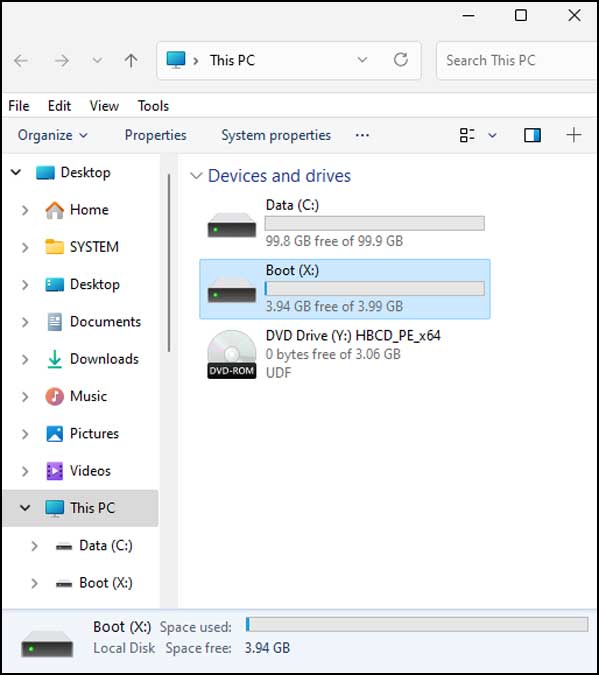
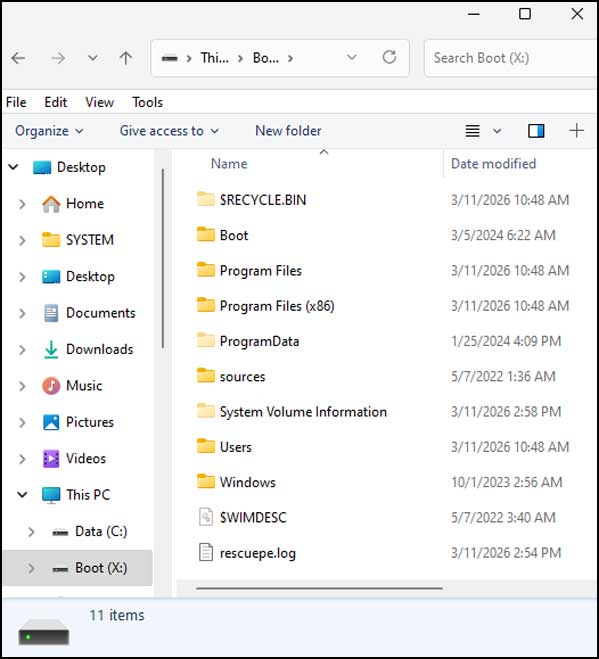
One major thing you will instantly notice when browsing the files on your computer after booting your PC with Hiren’s is that you will have a brand new drive called Boot. This drive is most likely assigned with the drive letter X. This is not actually your physical Windows drive, but rather a temporary RAM disk created strictly in the system memory. It is used so the operating system can keep the internal hard drive completely offline, which allows you to fix locked files and run deep scans that would not be possible if Windows was actively running off the C drive.
7. Locate Your Local Hard Drive
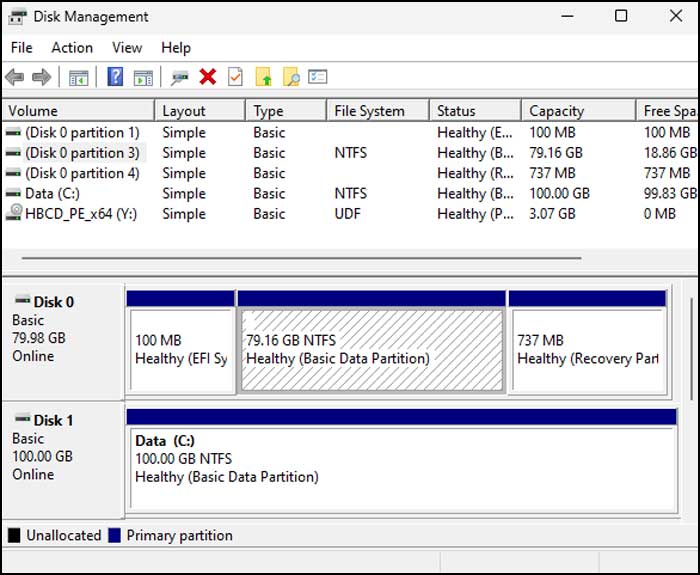
If you have a secondary drive installed in the computer, or multiple partitions, they will naturally shift their drive letters while inside this temporary PE environment. Your actual local Windows drive will most likely show up and even have the drive letter C assigned to it, exactly as seen in the image below with the Data drive. Always double-check the total capacity size to ensure you are modifying the correct physical disk.
8. Avoid Confusing the Boot Folders
If you accidentally open the Boot drive (X:), you will see what actively appears to be a real Windows system drive. It contains familiar directories like a Program Files folder, a Users folder, and a Windows folder. Remember that this is just the temporary environment and any files saved here will vanish forever the second you reboot the computer.
9. Map Drives Using Disk Management
If your primary hard drive is not showing up in File Explorer at all, the partition might simply be unmapped. You can easily go into the native Disk Management utility and see your raw Windows drive sitting there. You can even right-click the volume to assign it a temporary drive letter and manually access the raw files if needed.
As you can see, Hiren’s Boot CD is a powerful tool that you can use to recover and repair your computer when it decides to stop working so give it a shot!
For additional training resources, check out our online IT training courses.
Check out our extensive IT book series.