Easily Change you Computer’s MAC Address
Every device that connects to a network, whether it’s an internal network or external network such as the Internet has a MAC Address (media access control address). A MAC address is a unique identifier that is assigned to the device by the manufacturer. They are also known as a hardware address, burned in address (BIA) or physical address and should not to be confused with an IP address.
From a networking standpoint, the MAC address operates at Layer 2 of the OSI model, which is responsible for data link communication. This makes the MAC address essential for local network traffic, switches, and Ethernet-based communication. Unlike IP addresses, which can change depending on network configuration, MAC addresses are designed to uniquely identify hardware across the world, helping prevent address conflicts on a local network.

Yes everyone knows you need an IP address for network communication but the MAC address for addressing of Ethernet packets from device to device (MAC address to MAC address). The ARP (address resolution protocol) is used to get the MAC address of the next hop for packet transfer. The IP address is used first to check is if the destination address is in the same IP network as the sending computer or device.
This relationship between IP addresses and MAC addresses is critical for proper network functionality. When a device wants to communicate with another system on the same local network, it must know the destination MAC address in order to build the Ethernet frame correctly. ARP acts as the translator between logical addressing (IP) and physical addressing (MAC), ensuring data reaches the correct hardware endpoint efficiently and reliably.
Even though MAC addresses are burned into the device you might have a reason you need to change this address. Let’s say you have some software that is registered to the MAC address of your computer for licensing purposes. Then you replace your network card because it went bad and now you have a new MAC address and the software won’t work anymore because it’s not the same one it was registered to. You can still change the address or rather “spoof” it to make your computer think it has the MAC address of the original network card, assuming you know what it was.
MAC address spoofing is also commonly used in testing environments, virtual machines, privacy-focused setups, and certain enterprise network scenarios. Network administrators may temporarily change MAC addresses for troubleshooting, bypassing MAC-based access controls, or simulating multiple devices on a network. While this is a legitimate technique when used responsibly, it should always be performed in compliance with organizational policies and licensing agreements.
To change this address you need to go to Device Manager and find your network adapter. You may have more than one in the list depending on if you have a wireless adapter etc. Once you find the network adapter right click it and go to Properties. From there go to the Advanced tab and then the Network Address setting.
The exact wording of the setting may vary depending on the network adapter manufacturer and driver version. Some adapters label it as “Locally Administered Address” instead of “Network Address.” If this option does not appear, it may indicate that the network driver does not support MAC address modification through Device Manager, in which case alternative methods or updated drivers may be required.
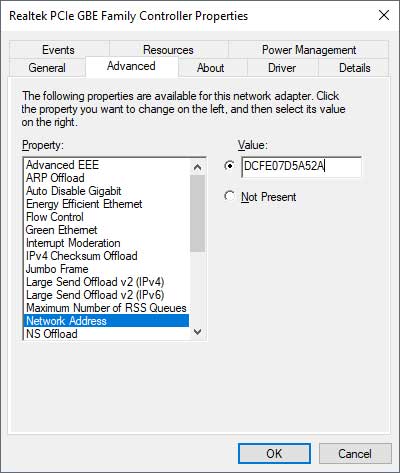
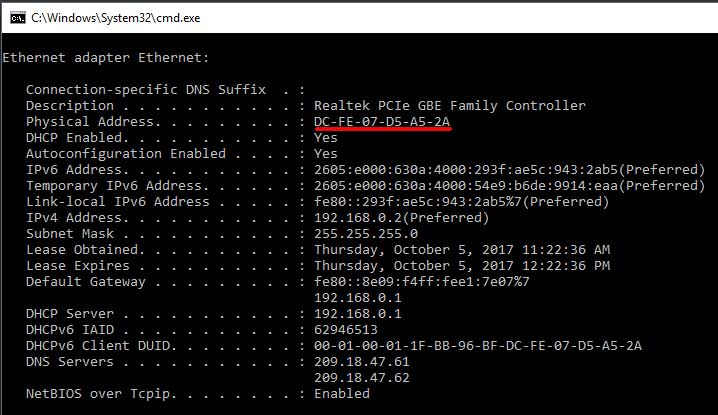
In the Value box enter the new MAC address of the one from your old network adapter without the colons. So in other words don’t enter it like this DC:FE:07:D5:A5:2A. Then just click ok and you should be good to go. If you want to confirm that it was changed you can run a ipconfig /all from the command line. You can also do this to check the MAC address of your old network adapter before taking it out.
After applying the change, you may need to disable and re-enable the network adapter or reboot the system for the new MAC address to take full effect. Verifying the change using built-in command-line tools helps ensure the system is correctly reporting the updated address and that network connectivity is functioning as expected.
You might want to make a note of the original MAC Address in case you want to change it back. Selecting the Not Present radio button should make it read the original address of the device itself and put it back to the way it was.
Keeping a record of the original MAC address is considered a best practice, especially in managed IT environments. Restoring the factory-assigned address can help resolve network authentication issues, reconnect to secured networks, or comply with hardware inventory and auditing requirements.