Last Updated on April 12, 2026
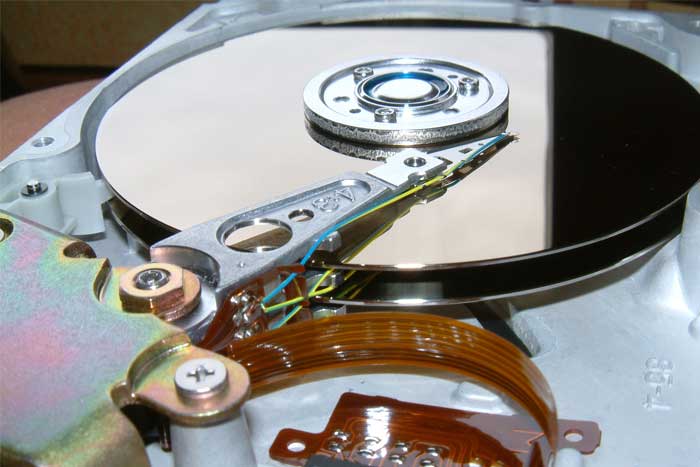
Hard drives are the component inside computers that store your information in the form of files. They are also what your operating system is installed on. Without a hard drive you can’t store any information on a computer. While you can boot an operating system from external media, a dedicated internal drive is required for permanent storage and system performance.
The Role of the Hard Drive Interface
When we talk about SATA and SAS, we are talking about the interface, the language and the physical connection the drive uses to talk to the rest of the computer.
- Consumer Interfaces (SATA): Designed for simplicity and high capacity. These are meant for “single-stream” tasks, like opening a document, playing a game, or watching a movie.
- Enterprise Interfaces (SAS): Designed for high-availability and “multi-stream” tasks. These are built for servers that need to handle hundreds of users requesting different files all at the exact same time.
There are many types of hard drives available for use in servers and workstations. The type of drive used will depend on the function of that computer and also on your budget.
You may be wondering how SATA compares to SAS and if you should and can use SAS drives in your computer.
Both SATA and SAS are based on full duplex, switched serial point to point connections, which simplifies installation compared to older legacy standards. Plus they use the same pin-out for data and power connections but the two connectors are physically separated for SATA. It is possible to attach a SATA drive to a SAS controller, but you cannot attach a SAS drive to a standard SATA controller. SAS controllers are backward compatible with SATA, but SATA controllers do not understand the SAS command set. Both also allow for device hot-plugging.
Physical and Logical Differences
While both drives use serial technology to move data, the way they handle errors and power is very different.
The Data Path: SAS drives are “Full Duplex,” meaning they can read and write data at the same time. SATA drives are “Half Duplex,” meaning they can only do one or the other at any given moment. This makes SAS significantly more efficient in a busy server environment.
The Physical Connector: If you look at the back of the drives, they look almost identical. However, a SAS drive has a small piece of plastic (a “bridge”) that connects the data and power segments. Standard SATA cables cannot plug into a SAS drive because of this bridge. This is a safety feature to prevent a user from plugging a drive that requires a high-end controller into a basic home motherboard.
SATA specifications:
- Serial point to point architecture
- Uses the ATA command set
- Higher storage capacity than SAS drives
- Lower cost per GB
- Drives spin at 7.2k RPMs
SAS specifications:
- Uses the SCSI command set
- Error recovery and error reporting
- Higher performance
- Higher reliability
- Designed for multi user environments
- Can support both SAS and SATA drives
- Uses the World Wide Name (WWN) naming convention
- Drives spin at 15k RPMs
So while you technically could run SAS drives in your PC it would involve getting a SAS controller connected via a PCI-Express expansion slot. You would also have less storage space than if you went all out on a huge SATA drive. It may also be a little noisy since the drives spin so much faster.
Ultimately, while SAS offers superior reliability and speed for multi-user environments, SATA remains the better choice for individual users due to its significantly lower cost-per-gigabyte and ease of use. For those needing more speed than a standard 7.2k RPM SATA drive, moving to an SSD is generally more effective than investing in a complex SAS setup for a home computer.