Last Updated on July 25, 2026
Selecting the right broadband service for your household determines how smoothly your family streams 4K video, joins video calls, and downloads large files. Coaxial cable networks and fiber optic lines represent the two main high-speed wired choices in most residential markets today. Each technology relies on entirely different physical mediums to transmit data from your provider to your living room.
Broadband performance varies dramatically depending on whether your internet traffic travels over copper shielding or glass filaments. Service providers aggressively market high-speed packages, but maximum download numbers tell only part of the story. Understanding how these two distinct connection types handle bandwidth, uploads, and signal loss helps you choose the best service for your budget. Another factor for internet speed is your web hosting company. Getting a top web hosting company can put a web site above the rest.
Primary Differences in Technology
1. Cable Broadband Overview
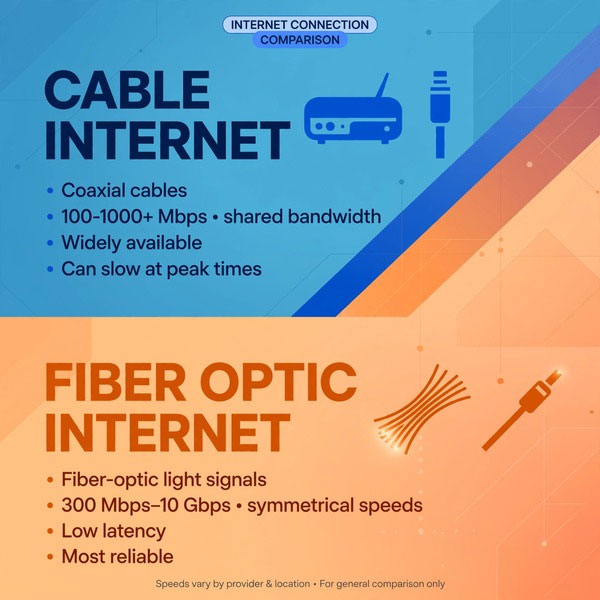
Coaxial cable connections send electrical data signals across insulated copper wiring originally run for television broadcasts. Your modem receives these high-frequency radio signals and converts them into standard digital packets for home routers. Local street cabinets bundle traffic from dozens of nearby homes onto shared neighborhood trunks. High network traffic during evening hours sometimes creates temporary bottlenecks for heavy internet users on the node. Coaxial infrastructure offers widespread availability because television providers laid these cable lines decades ago.
2. Fiber Optic Broadband Overview
Fiber optic systems convert digital data into laser light beams that travel inside flexible glass threads about the thickness of a human hair. An optical network terminal installed outside or inside your home converts those incoming light pulses back into network data. Light travels through glass at near-instantaneous speeds without generating heat or electrical resistance. Fiber lines deliver dedicated signal paths that remain completely unaffected by surrounding network activity or heavy neighbor usage. Telecommunication companies actively construct new fiber pathways to expand gigabit coverage nationwide.
Performance, Latency, and Cost Breakdown
1. Speed and Bandwidth Capacity
Coaxial cable networks easily deliver fast download speeds between 200 Mbps and 2,000 Mbps through current DOCSIS protocol updates. Upload capacity on cable lines lags significantly behind, generally capping out between 15 Mbps and 50 Mbps. Fiber optic lines offer true symmetrical performance, matching download speeds with equal upload speeds ranging from 1,000 Mbps to 5,000 Mbps. Fast upload speeds accelerate cloud video backups, live video broadcasting, and large project uploads. Low latency on fiber lines also reduces lag during competitive online multiplayer gaming.
2. Signal Stability and Line Security
Copper coaxial lines remain susceptible to environmental interference, signal noise, and extreme temperature fluctuations. Corrosion on outdoor splitters or damaged line shielding can cause random connection drops and degraded speeds. Glass fiber strands do not conduct electricity, making them completely immune to electromagnetic interference, lightning strikes, and moisture. Security on fiber lines is exceptionally high because tapping a glass cable physically disrupts the light signal and breaks the connection. Cable modems rely on modern software encryption to prevent unauthorized interception across shared neighborhood lines.
3. Pricing and Regional Availability
Cable internet enjoys near-universal availability across urban, suburban, and many rural communities. Standard cable packages cost between $45 and $85 per month depending on chosen speed tiers and promotional discounts. Fiber optic availability requires brand new underground or utility pole fiber deployment, making it less accessible in older rural areas. Residential fiber service usually ranges from $50 to $100 per month for multi-gigabit speeds, making it extremely cost-effective per megabit. Installation usually requires professional setup to run fresh fiber lines directly into your residence.