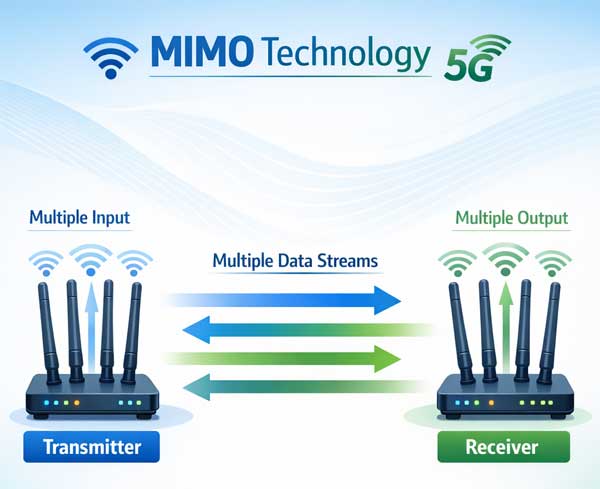
MIMO stands for Multiple Input Multiple Output, a wireless communication technology that uses multiple antennas at both the transmitter and receiver ends to improve data throughput and reliability. Unlike traditional single-antenna systems, MIMO leverages spatial diversity and multiplexing to send and receive multiple data streams simultaneously over the same frequency channel.
This approach significantly enhances network performance without requiring additional bandwidth or increased transmission power. MIMO is a cornerstone of modern wireless standards, enabling faster speeds and better coverage in environments with high interference or multiple users.
How Does MIMO Work?
At its core, MIMO exploits the principle that radio signals can take multiple paths from transmitter to receiver due to reflections, scattering, and diffraction. Instead of treating these paths as interference, MIMO uses them to transmit separate data streams. Here’s how it works:
- Multiple Antennas: Both ends of the link have multiple antennas (e.g., 2×2, 4×4 configurations).
- Spatial Multiplexing: Different data streams are transmitted simultaneously across different antennas.
- Signal Processing: Advanced algorithms reconstruct the original data at the receiver by separating overlapping signals using channel state information.
- Beamforming: MIMO systems can direct signals toward specific devices, improving signal strength and reducing interference.
The result? Higher throughput, better reliability, and improved spectral efficiency.
Standards That Use MIMO
MIMO is not just a concept—it’s embedded in nearly every modern wireless standard:
- Wi-Fi (IEEE 802.11):
- 802.11n introduced MIMO for the first time, enabling speeds up to 600 Mbps.
- 802.11ac (Wi-Fi 5) expanded MIMO capabilities with multi-user MIMO (MU-MIMO).
- 802.11ax (Wi-Fi 6) improved MU-MIMO for both uplink and downlink, supporting more simultaneous connections.
- Cellular Networks:
- 4G LTE adopted MIMO for higher data rates and better coverage.
- 5G uses Massive MIMO, deploying dozens or even hundreds of antennas at base stations to serve multiple users concurrently.
- Future Standards:
- Research for 6G focuses on adaptive and intelligent MIMO systems for ultra-low latency and extreme data rates.
Why is MIMO Important?
- Higher Speeds: By transmitting multiple streams, MIMO dramatically increases data rates without extra spectrum.
- Better Reliability: Multiple paths reduce the impact of fading and interference.
- Improved Coverage: Beamforming ensures stronger signals even in challenging environments.
- Scalability: Essential for IoT, AR/VR, and high-density networks.
Challenges and Considerations
While MIMO offers significant benefits, it comes with challenges:
- Hardware Complexity: More antennas mean higher costs and power consumption.
- Signal Processing: Requires sophisticated algorithms for channel estimation and interference management.
- Deployment: Massive MIMO in 5G demands advanced infrastructure and precise calibration.
The Future of MIMO
MIMO will remain relevant for decades. As data demands grow, technologies like Massive MIMO, beamforming, and full-duplex communication will evolve to support next-generation networks, including 6G and beyond.
For additional training resources, check out our online IT training courses.
Check out our extensive IT book series.