Computers have been around for a long time. Probably longer than most people thought they have been around for. Of course the first computers are nothing like the computers we are used to working with today. Even the computers from 5-10 years ago don’t compare to what we are using today.
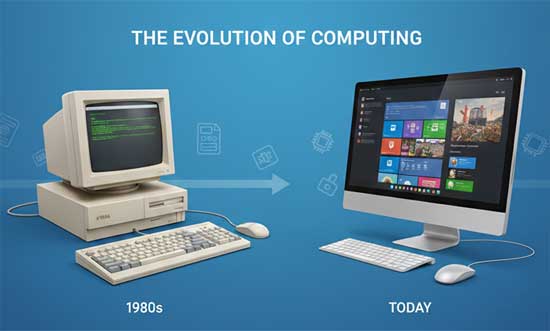
If you were ever wondering how the personal computer (PC) got started and when it all began here is a brief history lesson illustrating the key events in the computer’s evolution.
1958
- Texas Instruments completes building the first integrated circuit.
1960
- Digital Equipment introduces the first minicomputer, the PDP-1, for $120,000. It is the first commercial computer equipped with a keyboard and monitor.
1963
- Douglas Engelbart invents the mouse.
1964
- At Dartmouth College the BASIC programming language runs for the first time.
1968
- Robert Dennard gets a patent for a one-transistor DRAM cell and the basic idea in the three-transistor cell. (Dynamic RAM)
- Gordon Moore and Robert Noyce found Intel Corporation.
- Hewlett-Packard introduces first programmable scientific desktop calculator.
1969
- Advanced Micro Devices (AMD) is founded.
- IBM builds SCAMP, one of the world’s first personal computers.
1970
- Intel begins work on the layout of the circuit for what would be the 4004 microprocessor.
- Bell Labs develops UNIX.
1972
- Intel introduces its 200 kHz 8008 chip.
- Brian Kernighan and Dennis Ritchie develop the C programming language.
1973
- The first operational Alto computer is completed at Xerox PARC.
1974
- Intel releases its 2 MHz 8080 chip, an 8-bit microprocessor.
1975
- Bill Gates begins writing BASIC for the Altair.
- Bill Gates and Paul Allen found Microsoft.
- IBM’s Entry Level Systems unit unveils the IBM 5100 Portable Computer.
1976
- Steve Wozniak and Steve Jobs finish work on a computer circuit board, called the Apple I computer.
- Steve Jobs and Steve Wozniak incorporate the Apple Computer Company.
- Advanced Micro Devices (AMD) and Intel sign a patent cross-license agreement, giving Advanced Micro Devices the right to copy Intel’s processor microcode and instruction codes.
- The trade name Microsoft is registered.
- Bill Gates drops out of Harvard to devote his full attention to Microsoft.
1977
- Microsoft creates the File Allocation Table (FAT) to store data on diskettes.
- Apple Computer releases Applesoft, their version of BASIC.
1981
- IBM released their new computer, named the IBM PC.
- Microsoft releases the MS-DOS operating system.
1983
- Apple introduces the first computer with a GUI (graphical user interface) called the Apple Lisa.
1984
- Apple releases the smaller Macintosh computer.
1985
- Microsoft releases its first Windows operating system.
1990
- Microsoft launches Windows 3.0, which becomes a major success and popularizes GUI-based computing.
1991
- Linus Torvalds releases the first version of Linux, an open-source operating system that becomes a cornerstone of modern computing.
1993
- Intel introduces the Pentium processor, marking a leap in CPU performance.
1995
- Microsoft releases Windows 95, integrating the Start menu and taskbar, revolutionizing PC usability.
- The Internet becomes mainstream, with the launch of Netscape Navigator and widespread adoption of web browsing.
1998
- Google is founded, changing the way people search and interact with information online.
2001
- Microsoft launches Windows XP, one of the most popular and longest-supported operating systems.
- Apple introduces Mac OS X, bringing a modern, Unix-based architecture to its systems.
2004
- Facebook launches, signaling the rise of social media and its integration with personal computing.
2007
- Apple releases the iPhone, merging computing and mobile technology, and sparking the smartphone era.
2009
- Microsoft releases Windows 7, widely praised for its stability and performance.
2012
- Windows 8 introduces a touch-friendly interface, reflecting the growing influence of tablets and hybrid devices.
2015
- Microsoft launches Windows 10, a unified platform across PCs, tablets, and phones, with continuous updates.
2020
- Apple begins transitioning Macs to Apple Silicon (M1) chips, delivering major performance and efficiency gains.
2021
- Microsoft releases Windows 11, featuring a redesigned interface, improved security, and integration with Android apps.
2023–2025
- AI integration becomes mainstream in operating systems and productivity tools, with features like Copilot in Microsoft 365.
- Quantum computing research accelerates, though still in experimental stages.
2026
- PCs continue evolving with ARM-based processors, cloud-first operating systems, and AI-driven optimizations.
- Hybrid devices and virtual desktops dominate enterprise environments, while gaming PCs push boundaries with advanced GPUs and DDR5 memory.