Last Updated on April 27, 2026
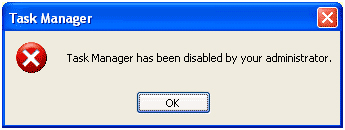
The Windows Task Manager is one of the most important tools in your troubleshooting arsenal. It allows you to kill unresponsive programs, monitor your CPU and RAM usage, and see exactly what is running in the background. However, you might occasionally press Ctrl + Alt + Delete only to be greeted by a frustrating error message: “Task Manager has been disabled by your administrator.”
If you are using a computer in a corporate office or a school, this is usually a deliberate choice made by your IT department. They use Group Policy to lock out the Task Manager so that users do not accidentally stop critical security services.
If this is happening on your personal home computer, it is almost certainly the result of a malware infection. Viruses and spyware often “hijack” this setting to prevent you from ending their malicious processes. Even after you remove the virus, the restriction often stays stuck in the “Disabled” position.
Perform a Modern Security Scan
Before you fix the setting, you need to make sure the “thief” is out of the house. In the past, tools like Spybot or Security Essentials were the standard, but today, Windows 10 and 11 rely on more robust protection. You must eliminate the root infection first.
1. Run a Full Windows Defender Scan
First, run a full scan using Windows Security (Defender). This built-in tool catches most modern threats trying to lock down your system. Make sure your virus definitions are completely up to date before starting the scan.
2. Scan with Malwarebytes
Next, download the free version of Malwarebytes. It is highly effective at finding the specific registry hijacks that disable the Task Manager. This secondary scan catches stubborn scripts that Defender might miss.
3. Utilize Safe Mode
I highly recommend running these scans in Safe Mode. This ensures the malware isn’t active and protecting itself while you try to delete it. Booting into Safe Mode stops background startup apps from interfering with the quarantine process.
The Registry Fix Command (Fastest Method)
If you are comfortable with the command line, this is the quickest way to force the Task Manager back on. This command manually goes into your system’s “Policies” folder and resets the “Disable” value to zero. It bypasses the need to click through multiple registry menus.
1. Open the Command Prompt as Admin
Click Start, type CMD, and select Run as Administrator. You must have administrative privileges for this command to execute properly. A standard user prompt will just return an access denied error.
2. Execute the Registry Command
Copy and paste the following command exactly as shown. Type REG add HKCU\Software\Microsoft\Windows\CurrentVersion\Policies\System /v DisableTaskMgr /t REG_DWORD /d 0 /f into the prompt. Double check the spacing before moving forward.
3. Confirm the Execution
Press Enter to run the registry modification. If the system asks for confirmation, type Y or click Yes. The command line should display a success message immediately after execution.
Manual Registry Edit
If the command line didn’t work, you can go into the Registry Editor yourself to delete the restriction. Malware can hide this restriction in one of two places, so you should check both. Proceed carefully when modifying registry keys manually.
1. Launch the Registry Editor
Press the Windows Key + R, type regedit.exe, and press Enter. This opens the graphical interface for the Windows Registry. Accept the User Account Control prompt if it appears on your screen.
2. Check Current User Policies
First, navigate to the Current User policies in the left-hand sidebar. Go to HKEY_CURRENT_USER\Software\Microsoft\Windows\CurrentVersion\Policies\System. If you do not see a “System” folder here, it means this specific area is clean, and you can move to the next step.
3. Check Local Machine Policies
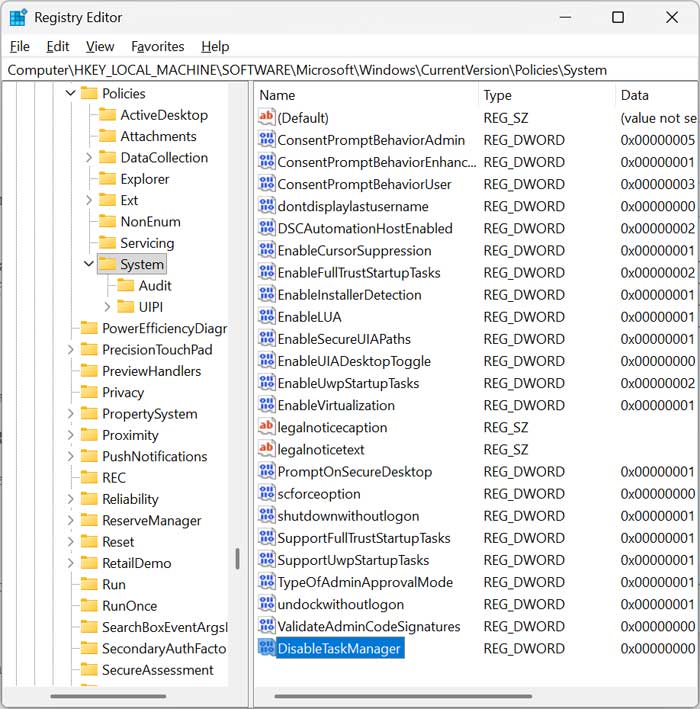
Next, check the Local Machine policies for the same restriction. Navigate to HKEY_LOCAL_MACHINE\SOFTWARE\Microsoft\Windows\CurrentVersion\Policies\System. Malware often targets this system-wide folder to lock out all user profiles at once.
4. Locate the Malicious Value
Once you click on the System folder, look at the right-hand pane for a value named DisableTaskMgr. Some malware will spell this out fully as DisableTaskManager. Look closely at the data column to see if it is set to a value of 1.
5. Delete the Restriction
If you see either of those values, right-click on them and choose Delete. Confirm the deletion when prompted by the system. Close the Registry Editor and try opening your Task Manager again.
1. Open Group Policy Editor
Press Windows Key + R, type gpedit.msc, and press Enter. This launches the Local Group Policy Editor console. It might take a few seconds to load all the administrative templates. If you are running the Pro or Enterprise version of Windows 10 or 11, you can use the Group Policy Editor. This is often the most permanent fix because it overrides other registry settings. You can also enable the Local Group Policy Manager on Windows Home editions.
2. Navigate to the Correct Folder
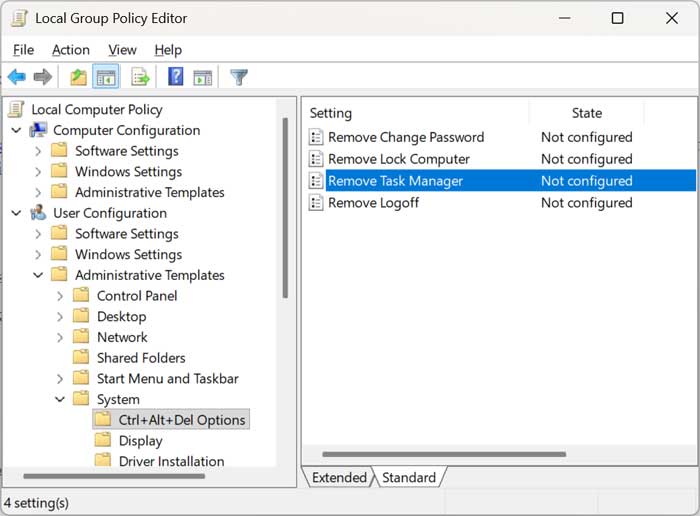
Navigate to User Configuration > Administrative Templates > System > Ctrl+Alt+Delete Options. Expand each folder in the left pane to drill down to the correct path. The right pane will populate with a few specific policy settings.
3. Modify the Remove Task Manager Policy
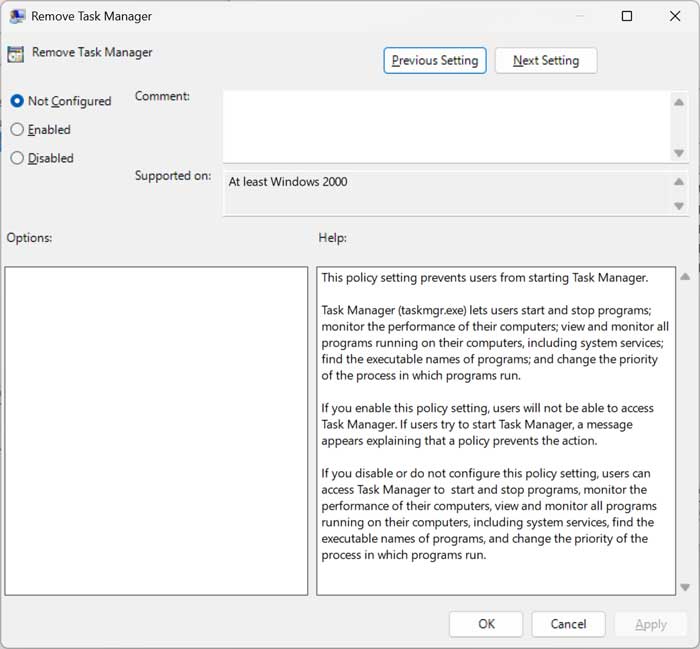
In the right pane, double-click on Remove Task Manager. This opens a new configuration window for this specific system policy. By default, this should be unconfigured on a healthy home computer.
4. Change the Policy State
Set the policy to Not Configured or Disabled. Choosing either of these options tells Windows to stop blocking the Task Manager executable. Do not set the policy to Enabled.
5. Apply the Changes
Click Apply and then OK to save your modifications. You can now close the Group Policy Editor completely. Test your Task Manager shortcut to see if access is restored.
Use a Pre-Made Registry Fix
If you do not want to type commands or dig through folders, you can use a pre-made registry fix. Simply download the .reg file from a trusted source or create your own using a basic text editor. This automates the manual registry steps entirely.
1. Save the Registry File
Save the downloaded .reg file directly to your desktop. This makes it easy to find and execute. Make sure the file extension actually says .reg and not just .txt.
2. Run the Registry File
Double-click the file to initiate the automated registry merge. Windows will instantly recognize this as a system configuration change. It will pause to ask for your explicit permission.
3. Accept User Account Control
When Windows User Account Control asks if you want to run it, click Yes. You must have administrator rights to approve this prompt. Standard accounts cannot merge registry files.
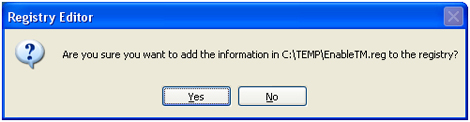
4. Confirm the Registry Warning
A Registry Editor warning will ask if you want to add the information to the registry. Click Yes to finalize the process. A final success box will appear confirming the keys were injected into your system.
Pro Technician Troubleshooting and FAQ
Sometimes fixing the Task Manager reveals deeper issues within your Windows operating system. Advanced malware employs multiple layers of defense to keep you locked out. Here are some common hurdles you might face during this repair process.
1. What if the Registry Editor is also disabled?
Malware often disables the Registry Editor (regedit) at the exact same time it disables the Task Manager to prevent you from fixing the problem. If you try to open regedit and get an “Administrator has disabled” error, use the Command Prompt (Method 2) mentioned above. The command line can often bypass these restrictions even when the windows-based interface is locked out.
2. Why does the Task Manager keep getting disabled after I fix it?
If you run these fixes and the Task Manager works for a few minutes but then mysteriously gets disabled again, you still have an active virus on your computer. Advanced malware runs a background “monitor” script that checks that registry key every few seconds and flips it back to “Disabled.” You must run a bootable offline antivirus scanner or perform a Windows “Reset this PC” if a standard scan cannot find the culprit.
3. Does this fix work for “Command Prompt has been disabled”?
Yes. You can use the exact same logic for many other disabled Windows features. Malware often targets the Registry Editor, the Command Prompt, and the Task Manager together. Using the Group Policy Editor is usually the best way to “mass-enable” these features if your user account has been stripped of its administrative power.