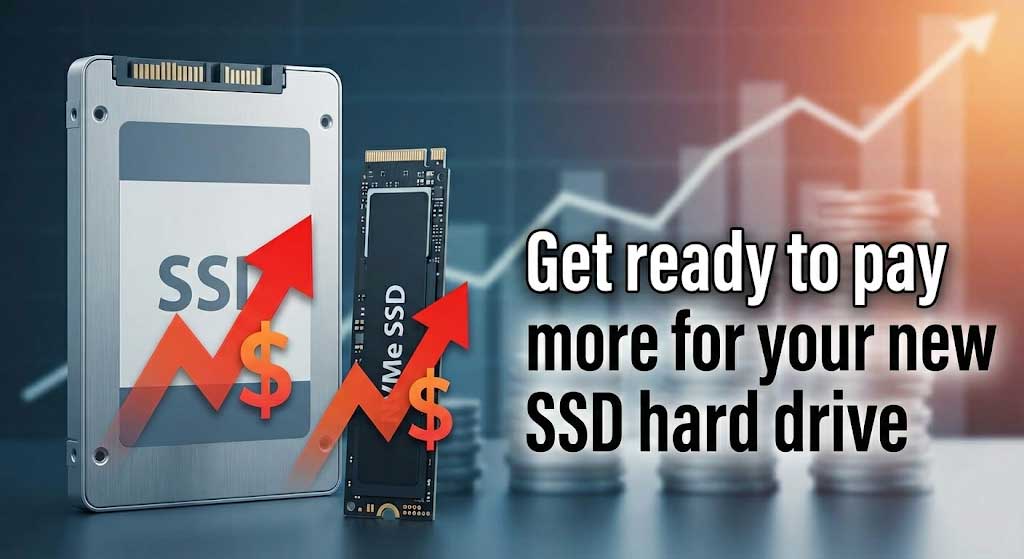
If you are looking to upgrade your computer with a larger or faster hard drive, then get ready to pay more to do so. SSD hard drives are getting a lot more expensive in 2026, and AI data centers are eating a big chunk of the world’s NAND supply, so this won’t blow over next month.
What’s Actually Going on with SSD Prices
Think back to when SSDs kept getting cheaper every few months, that era’s over, at least for now. Market trackers are reporting that the contracts for the flash chips inside SSDs (NAND) are jumping by more than half in just the first quarter of 2026, which is wild for a single quarter. Client SSD contracts are set to climb by around 40% or more, and some brands are already pushing retail prices way beyond what they cost in 2024–2025. In some cases, certain SSD models have gone up more than 2× in just a few months, especially higher‑end drives.
On the enterprise side, the numbers are even more brutal. One analysis shows a 30 TB enterprise SSD going from roughly 3,000 dollars in mid‑2025 to almost 11,000 dollars in early 2026, which is more than a 250% jump. That gap means SSD capacity in data centers now costs over 16 times what hard drives cost for the same space, so a lot of big buyers are back to mixing HDDs and SSDs instead of going all‑flash.
Why AI Is Messing with Your Storage Budget
This isn’t just “normal” supply and demand; AI has flipped the table. Huge cloud platforms and AI players are locking in multi‑year deals for DRAM, HBM, and NAND to feed their GPU servers and inference clusters, grabbing a massive share of global output before it ever has a chance to become your next gaming SSD. One estimate says Nvidia’s next‑gen AI servers alone could chew through tens of millions of terabytes of NAND in 2026 and well over a hundred million terabytes in 2027, which is approaching 10% of global demand on its own.
At the same time, memory makers aren’t slamming the gas on new fabs like they used to. After years of boom‑and‑bust cycles, they’re more interested in keeping prices healthy than flooding the market and crashing them again, so they’re being careful about adding capacity. They’re also shifting the best production lines toward server and AI‑focused products, leaving fewer wafers for consumer drives and making it harder for retail SSD prices to stay low.
What This Feels Like for Regular Buyers
If you’re shopping for an SSD right now, you’ve probably noticed the sticker shock. Many mainstream NVMe drives cost noticeably more than they did in late 2025, and the higher you go in capacity (4 TB, 8 TB), the uglier it gets. Some price trackers and articles point out that a bunch of SSDs have effectively doubled compared to their cheapest points in the last couple of years.
The annoying part is that this isn’t just a quick spike you can wait out for a month. Analysts expect tight NAND supply and elevated prices to run through the rest of 2026, and some forecasts say we could still be feeling it into 2027 if AI demand keeps scaling up. In other words, betting everything on “I’ll just wait for Black Friday, and it’ll be cheap again” might not work like it did before.
How to Play SSD Purchases in 2026
If you need more storage this year, you still have options, but you just have to be a bit more strategic.
Prioritize real problems: Replace dying drives or tiny boot SSDs that are constantly full but think twice before upgrading a perfectly fine 1 TB drive just to shave a second off game load times.
Stay brand‑flexible: Instead of chasing a specific “halo” model, look at capacity, interface (PCIe 3/4/5), endurance, and warranty, then pick whichever decent‑reviewed drive is priced best that week.
Watch for weird deals: Retailers still run promos and clear out old stock bought at pre‑spike prices, so using price‑history tools and wish lists can snag you a semi‑reasonable deal in a bad market.
Mix fast and cheap storage: Use a smaller, quick NVMe drive for your OS and main games, then throw bulk files, media, and backups onto cheaper SATA SSDs or old‑school HDDs.
Consider buying “once, not twice”: If the jump from, say, 1 TB to 2 TB isn’t outrageous right now, it may be smarter to grab the larger drive and avoid being forced back into an even more expensive market later.
Bottom line: the SSD market in 2026 is being pulled around by AI server demand, not just normal PC upgrades, and that pressure isn’t going away quickly. Treat SSDs like a resource that’s going to stay pricey for a while and plan your builds and upgrades around that new reality