Last Updated on July 19, 2026
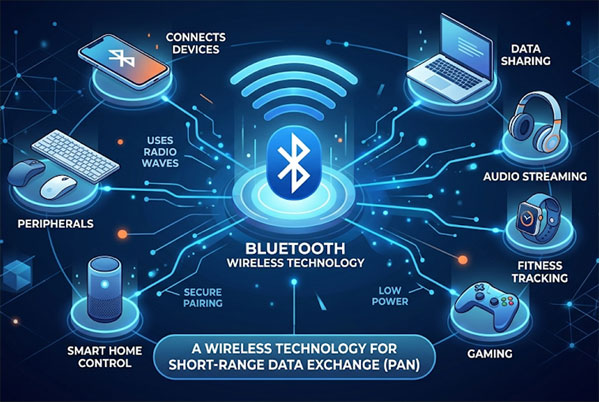
Bluetooth is a wireless communication standard designed for short‑range data and voice transmission between both mobile and stationary devices. It was originally developed by a collaboration of technology companies including Ericsson, Intel, Nokia, and Toshiba with the goal of eliminating cables between commonly connected devices. Over time, Bluetooth has evolved into a global standard for low‑power, short‑distance connectivity.
Bluetooth allows devices such as smartphones, computers, and accessories to communicate without physical connections, making it ideal for portable electronics and hands‑free use.
How Bluetooth Wireless Technology Works
1. The Radio Frequency Band
Bluetooth operates in the unlicensed 2.4 GHz radio frequency band, which is shared by many consumer wireless technologies. Modern Bluetooth versions use intelligent frequency hopping to reduce interference from other devices operating in the same spectrum. This allows your headphones to work perfectly even when surrounded by dozens of active Wi-Fi routers.
2. The Device Pairing Process
Most Bluetooth connections are created through a process called pairing, where two devices securely recognize and authorize each other. Once paired, devices can automatically reconnect when they are within range. This eliminates the need to constantly re-enter passcodes every time you turn on your wireless keyboard.
3. Understanding Range Capabilities
Depending on the specific Bluetooth version and the hardware device class, Bluetooth connections typically support ranges from about 10 meters (30 feet) to well over 100 meters under optimal conditions. Thick concrete walls and metal interference will drastically reduce this maximum signal distance.
4. Managing Power and Data
Modern Bluetooth standards boast incredibly low power consumption, especially with Bluetooth Low Energy (BLE) protocols. The standard provides data rates sufficient for audio, input devices, and sensor data. It is not designed to replace high-bandwidth Wi-Fi connections for massive file transfers.
Modern Bluetooth Capabilities
1. Increased Data Speeds
While early Bluetooth versions supported limited data speeds, current versions of Bluetooth offer significantly improved performance. Bluetooth is now capable of supporting high-quality audio, faster data transfers, and longer ranges while maintaining excellent battery efficiency. The launch of Bluetooth 5.4 introduced major improvements for bidirectional communication.
2. Bluetooth Low Energy (BLE)
Bluetooth Low Energy (BLE), in particular, is designed for devices that need to operate for extremely long periods on very small batteries. A simple coin cell battery can power a BLE sensor for several years without needing a replacement. This makes it the absolute standard for the Internet of Things (IoT).
Common Uses of Bluetooth Technology
Bluetooth is widely used across consumer, automotive, medical, and industrial devices. Its flexibility and low power requirements make Bluetooth one of the most versatile wireless technologies available.
1. Consumer Electronics
The most recognizable application is connecting wireless keyboards and mice to desktop computers. Millions of users rely on Bluetooth daily to connect their phone headsets and earbuds for private listening.
2. Automotive and Navigation
The automotive industry uses the standard for car infotainment and hands-free systems to keep drivers focused on the road. It also powers the data sync for GPS devices and navigation systems to download live traffic updates.
3. Health and Smart Homes
The medical field utilizes the low-power standard to connect smartwatches and fitness trackers to health monitoring applications. Homeowners use it extensively to link smart home sensors and controllers for automated lighting and temperature control.
Bluetooth System Architecture
1. The Radio Transceiver
The Bluetooth core system consists of several key components working together. The first is a radio frequency (RF) transceiver specifically tuned for short-range wireless communication. This tiny chip physically sends and receives the radio waves.
2. The Baseband Processor
The second core component is a baseband processor that actively manages data transmission. This processor takes the raw digital data from your device and translates it into the radio signals. It handles all the complex timing and frequency hopping algorithms.
3. The Protocol Stack
The final component is a protocol stack that defines exactly how devices discover, connect, and exchange data. Together, these components enable Bluetooth devices to support different types of data, such as audio streams, control signals, and file transfers seamlessly.
Bluetooth Security and Device Trust
1. Core Security Implementation
Bluetooth security is managed through a combination of strict authentication, encryption, and authorization. Device manufacturers ultimately determine how security is implemented on their specific hardware. Modern Bluetooth standards typically mandate and enable secure, encrypted connections by default.
2. Device Trust Classifications
Bluetooth devices are generally classified into two distinct security categories. Trusted devices are hardware peripherals which have been permanently paired and granted full access to the host system. Untrusted devices are temporary connections which have strictly limited or absolutely no access to sensitive core files.
3. Service Level Requirements
Bluetooth services also have different security requirements depending on their function. Some services require both authentication and authorization, others require authentication only, and some are completely open for general access. These layered security protocols help protect users from unauthorized connections and malicious data interception.