
Last Updated on April 28, 2026
The Windows operating system runs on services and can’t function without them. There are many services running at all times with services depending on other services to run. Window has its own services and many programs you install will add services of their own that need to be running in order for the software to function properly.
Services are programs that run transparently to support other programs. Services load and start running when you turn on your computer whether or not you log into the computer. Most services are necessary and should not be terminated but that doesn’t mean all of them are. Sometimes services can cause problems such as your computer starting slowly or not starting at all.
Security Tip: While viruses can hide as services, modern malware often uses “living off the land” techniques, disguising itself with names very similar to legitimate Windows services. Always check the Path to executable in the service properties. If a “Windows” service is running from a temp folder or a user directory instead of C:\Windows\System32, that is a major red flag.
We can’t tell you what services to turn on and off since it varies from computer to computer but we can tell you how to check them to see what is running on your PC. In Windows 11, the quickest way to manage services is to right-click the Start button and select Task Manager, then head to the Services tab. For full control, you can still use the classic method: press the Windows Key + R, type services.msc, and hit Enter. This opens the full Management Console where you can deep-dive into service dependencies and recovery options.
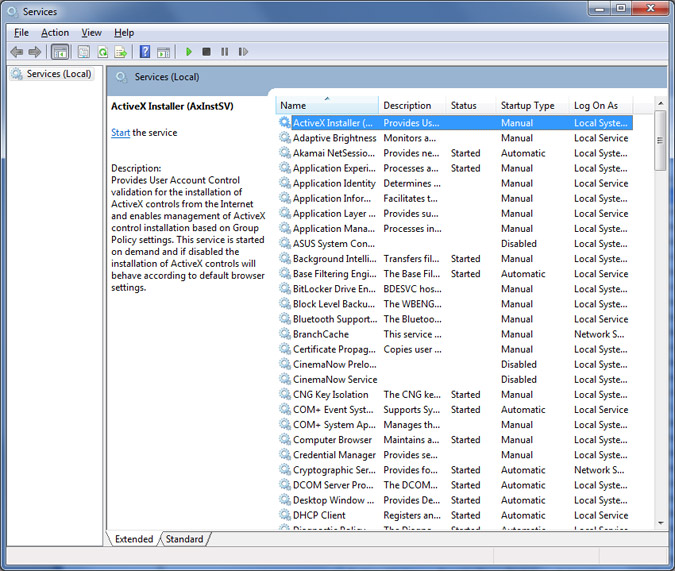
The services window will have information such as the name of the service, a description of what that services does, the status, such as started or stopped and if the service starts automatically with Windows, manually or is disabled.
You can double click the service to get more information or to edit its properties.
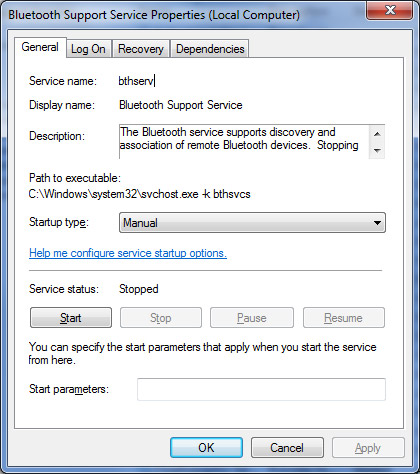
Here you can find the path that leads to the executable file for the service. You can also start and stop the service as well as change the startup type. This is a good place to check to make sure the executable is located where the service thinks it is in case the service won’t start.
Automating Fixes with the Recovery Tab
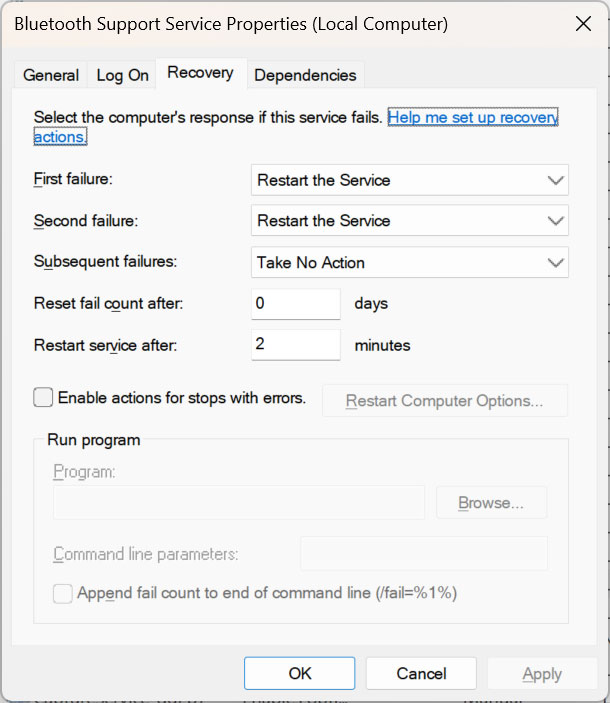
If a specific service keeps stopping, Windows can actually try to fix it for you.
- Double-click any service and go to the Recovery tab.
- Here, you can tell Windows what to do on the First failure, Second failure, and Subsequent failures.
- Setting these to Restart the Service is a great way to handle finicky print spoolers or third-party software services that crash due to temporary network blips.
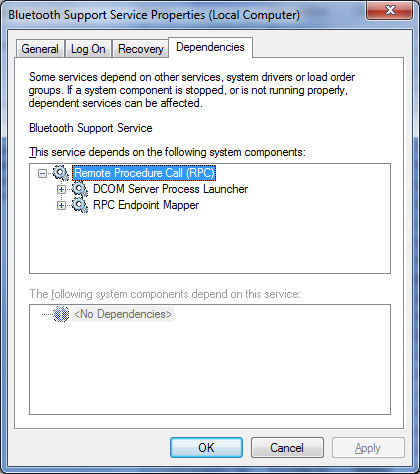
From the Dependencies tab you can see what other services this service needs to run properly. If the service won’t start you can look here to check and see what other services need to be running and make sure that they are.
Troubleshooting via PowerShell
Sometimes the Services GUI can hang if a service is “Stuck” in a stopping state. When that happens, PowerShell is your best friend.
- Get-Service: Lists all services and their current status.
- Restart-Service [ServiceName]: Forces a service to stop and start again immediately.
- Set-Service -Name [Name] -StartupType Disabled: Quickly prevents a problematic service from loading on the next boot if it’s causing your PC to blue screen.
If you get to know your services well you can start to get a feel of what they do and which are essential and spot any that don’t belong. There may also be a time when you will need to start a service that has stopped for some reason or to restart a service that is not behaving properly. Keep in mind that it’s not a good idea to play around here if you aren’t sure what you are doing because you can cause problems with your computer and cause programs or Windows itself to stop working.
For additional training resources, check out our online IT training courses.
Check out our extensive IT book series.