Last Updated on April 9, 2026
Have you ever wondered what was using up your hard drive space? Or have you come across a time when your hard drive was full and you couldn’t tell what was using up all the space so you can free some up? Browsing through your directory tree and checking the properties on levels upon levels of folders can be time consuming and frustrating and can be difficult to get the answer you are looking for.
SpaceSniffer is a classic, portable diagnostic utility that provides a real-time ‘treemap’ visualization of your storage. Currently, while many modern scanners prioritize raw speed, SpaceSniffer remains a favorite for IT professionals because of its dynamic interface. As it scans, the boxes on your screen grow and move, giving you an immediate visual cue of where the largest data blocks reside. Best of all, it is a single, portable executable, meaning you can run it directly from a USB toolkit without needing to install anything on the host computer.
To get an accurate picture of your drive space in Windows 11, you must right-click the SpaceSniffer executable and select Run as Administrator. Without these elevated privileges, SpaceSniffer will be ‘blind’ to system folders like System Volume Information and certain protected AppData directories, leading to a ‘Ghost’ reading where the tool shows significant unaccounted-for space.
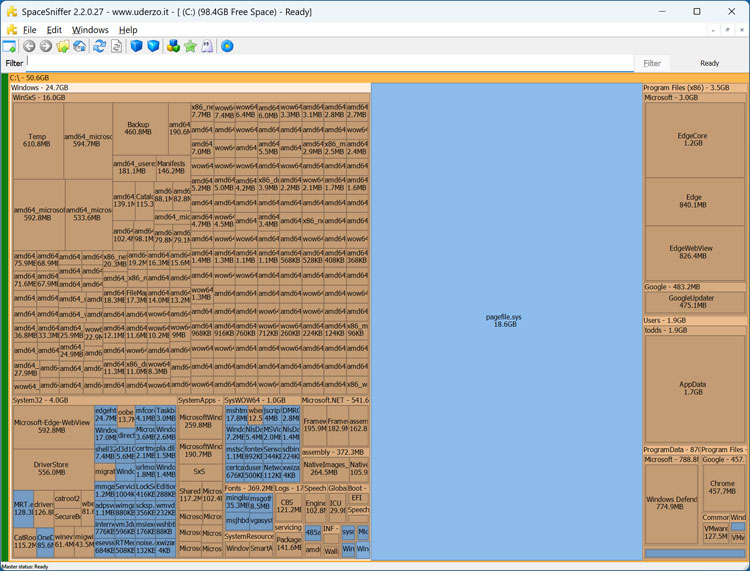
Clicking on one of the boxes that represents a folder will show more details about the size of items subfolders within that folder. Right clicking the box will bring up the typical options that you would get when right clicking on the folder itself in Windows Explorer such as cut, copy, delete, properties and so on. As you can see, when clicking on the Temp folder, it breaks it down into subfolders and right clicking on it gives us the typical File Explorer options.
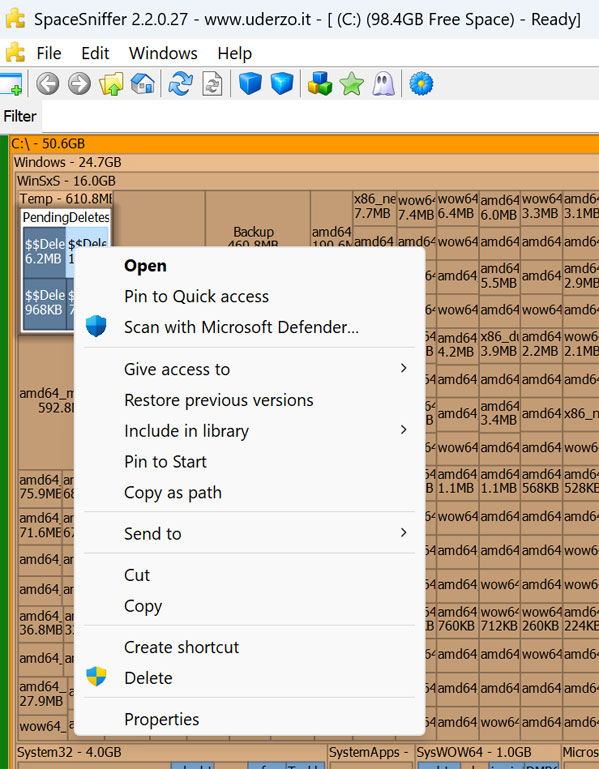
There is a toolbar at the top that gives you other options and features to help you diagnose your hard drive usage. The back, forward and home buttons work like a web browser to allow you to navigate your drives. There are also buttons to let you rescan your drive and change the detail level of the results. The use file classes style button changes the view and color codes it displays to show different types of file classes. Clicking on the star button will show you how much free space you have left. The ghost button will show space that is not known about or has not been scanned.
Once you find the culprit of your hard drive space usage you can click on it and choose Open and it will take you right to that folder. Then you can decide if you need to do anything like move or delete files to get your space back. Just be sure to make sure the files are something you should be moving or deleting before doing so! If you want to change the way the program looks and behaves you can go to the Configure settings under the Edit menu and change things such as display colors, fonts, animations and detail levels. There is also an option to export your scan results to a text file in case you need someone else to analyze the results for you.
SpaceSniffer can be downloaded for free from the official Uderzo software website. While it hasn’t received a major update in several years, it remains fully compatible with Windows 11 25H2. However, if you are scanning a high-capacity NVMe SSD and find the scan time too slow, we recommend using it alongside a modern MFT-based scanner like WizTree for the fastest results.
For additional training resources, check out our online IT training courses.
Check out our extensive IT book series.